



AI is easy to demonstrate.
It’s much harder to make dependable.
Almost anyone can open an AI tool, type in a question, and get an answer that looks impressive. That can be useful. It can also be misleading.
One good answer is not a business process.
It may have been the wording of the prompt. It may have been the model. It may have been the information supplied. It may have been luck.
You don’t build a business process around luck.
Start With the Business Problem
When we test AI, I don’t believe the first question should be, “Which AI platform should we buy?”
The better question is:
What specific business problem are we trying to solve?
Maybe your team spends too much time researching prospects. Maybe someone has to review the same type of financial information every month. Maybe an employee repeatedly turns notes into a standard report.
Define the task first.
Then define what a successful result looks like.
That second part is important. If you don’t know what good looks like, you have no reliable way to determine whether the AI performed well.
We need an expected outcome, not just an interesting output.
Test the Use Case, Not the Brand
There is a lot of brand loyalty developing around AI models.
That makes very little sense to me.
The model doesn’t get loyalty points. It either performs the task reliably or it doesn’t.
My approach is straightforward:
“Test them, the same thing, against various of the models.”
Give multiple models the same prompt, the same information, and the same expected outcome. Then compare the results.
Which model followed the instructions?
Which one missed important details?
Which one introduced information that wasn’t there?
Which one produced something your team could use?
The answer may be different depending on the task. One model might be better for research. Another may be better at reviewing structured financial information. A third may be better at turning raw notes into a polished first draft.
That’s fine.
You don’t have to declare one winner for every possible AI use case. You need to determine which model produces the most dependable result for the specific work being performed.
A Good Prompt Is Company Knowledge
Once you have a prompt that works, don’t leave it buried inside one employee’s chat history.
Chat history is not an operating system.
It is not documentation.
It is not a dependable place to preserve your organization’s intellectual property.
When we arrive at a useful result, I want to be able to ask:
“Please, with what we’ve learned together, please rewrite the prompt that I would use to make this a repeatable result.”
Then save it.
Save the working prompt. Save a sample of the expected output. Save any required source information, formatting instructions, limitations, and review criteria.
That package becomes a reusable organizational asset.
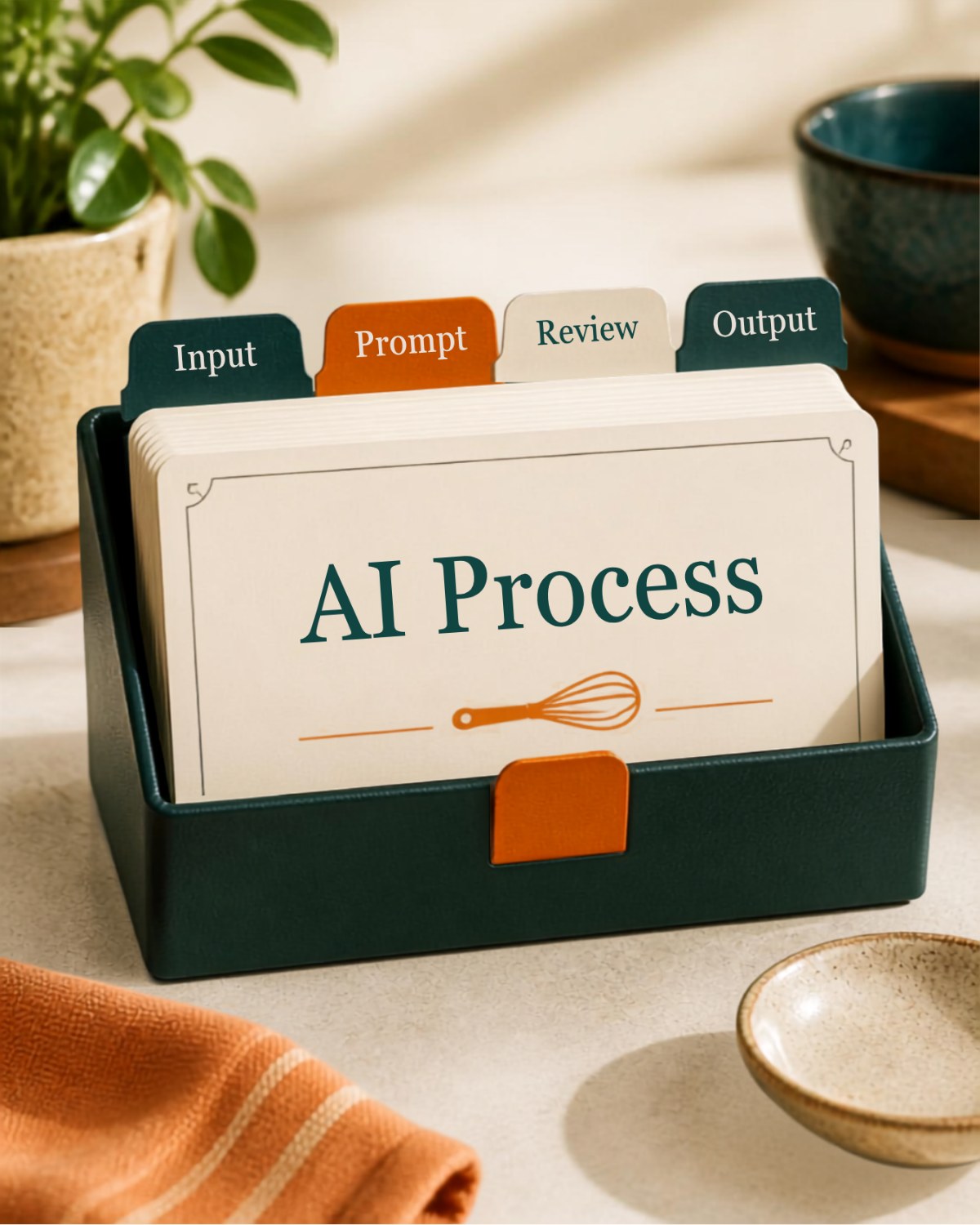
A complete AI process should identify:
- The business problem being solved
- The approved prompt
- The information required as input
- A sample of the desired output
- The model that produced the best result
- The person responsible for reviewing it
- The conditions that would cause the output to be rejected
Without that documentation, the process still belongs to the individual who figured it out.
What happens when that person changes roles, leaves the company, loses access to an account, or simply forgets how they got the original result?
You start over.
That is wasted effort.
Move From Experiment to Application
A chat window is useful while you’re experimenting. It is not always the best place to run a repeatable business process.
Once the process becomes dependable, operationalize it.
As I described during one of our AI discussions:
“Once we have the models that perform well, we turn those prompts into apps and lock it to the model that we’re getting reliable results from.”
This matters for several reasons.
First, the employee doesn’t have to remember the exact prompt.
Second, the process can require the correct information before it runs.
Third, you reduce the likelihood that someone casually edits the instructions and changes the result.
Fourth, you can control which model performs the work.
Instead of telling the team to “go use AI,” you give them a defined application that performs a defined task.
That is the difference between experimentation and implementation.
Keep the Human in the Process
Repeatable does not mean unsupervised.
AI output should still be reviewed by someone who understands the work being performed.
The reviewer needs to know what success looks like, what common errors to watch for, and when the result should be rejected.
This is particularly important when the output will affect:
- A client
- A financial decision
- A contractual obligation
- A regulated workflow
- The reputation of the organization
AI can accelerate work. It does not transfer accountability away from the business.
The person or organization using the result still owns the result.
Start Narrow and Earn the Right to Scale
Don’t start by turning on every AI tool for every employee and asking people to innovate.
That sounds exciting. Operationally, it creates a mess.
Start with one defined use case.
Choose something repetitive enough that improving it will matter, but controlled enough that a mistake won’t create an unacceptable outcome.
Then:
- Define the problem.
- Define the expected result.
- Test the same prompt across multiple models.
- Compare the results.
- Document the successful prompt and target output.
- Put the process into a controlled application.
- Require human review.
- Measure whether the process saves time or improves quality.
Then move to the next use case.
AI implementation should be iterative.
Try it. Test it. Evaluate it. Refine it. Replace what doesn’t work and preserve what does.
The goal isn’t to use more AI.
The goal is to produce better, faster, and more dependable business outcomes.
That only happens when we stop treating AI like a toy and start treating it like a process.