



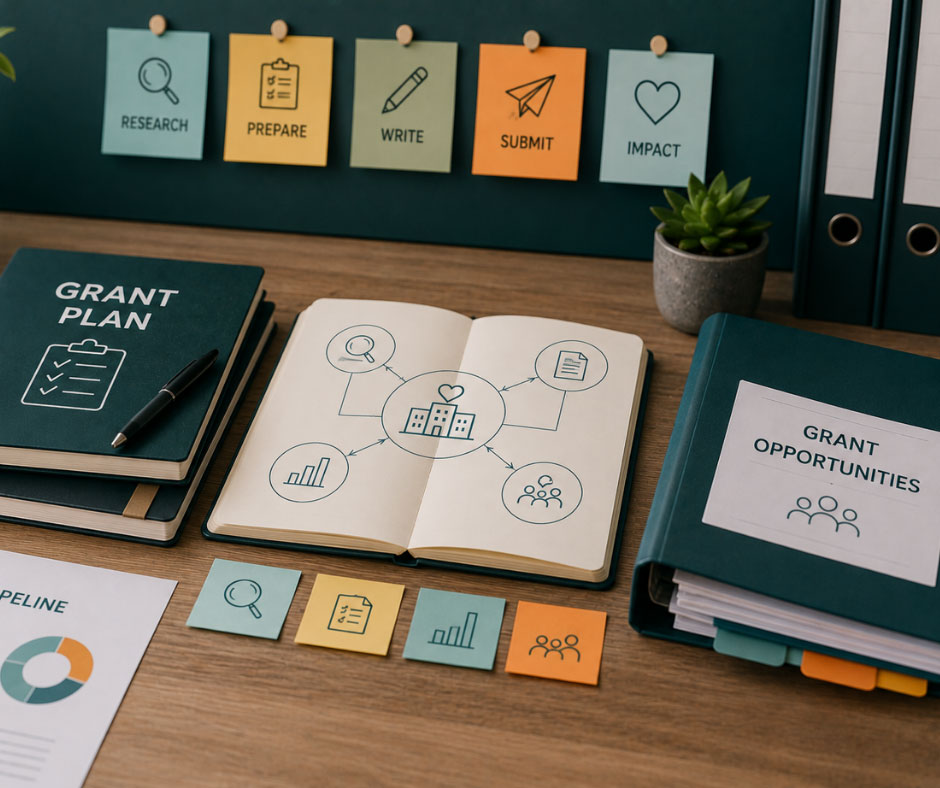
AI won't win grants for you—but it can help your team spend less time on administrative work and more time creating stronger proposals.
For many NonProfit leaders, grant funding is becoming more competitive every year.
Funders expect measurable outcomes.
Reporting requirements continue to grow.
Applications often require detailed documentation, supporting data, and measurable impact.
Meanwhile, your staff is already stretched thin.
It's no wonder Executive Directors are asking:
"Can AI help us with grant writing?"
The answer is yes—but probably not in the way you think.
Artificial Intelligence isn't a replacement for your grant writer, your program staff, or the relationships you've built with funders.
Instead, AI can help reduce repetitive administrative work, organize information, and create first drafts—giving your team more time to focus on strategy, storytelling, and demonstrating your organization's impact.
AI Doesn't Win Grants—People Do
Let's start with the biggest misconception.
AI doesn't know your community.
It doesn't understand your mission.
It hasn't built relationships with local foundations.
It doesn't know the unique needs of the people you serve.
Your team does.
What AI does well is helping staff organize information, summarize documents, generate first drafts, and streamline repetitive writing tasks.
Think of AI as a research assistant—not the author.
Every proposal should still be reviewed, refined, and approved by someone who understands your organization and the specific grant requirements.
Five Ways AI Can Support Your Grant Process
1. Organize Grant Research
Researching funding opportunities takes time.
AI can help your team organize publicly available information, compare funding priorities, summarize eligibility guidelines, and create research summaries.
However, eligibility requirements and submission instructions should always be verified directly with the grantmaker before applying.
2. Create Better First Drafts
Many grant applications ask similar questions about your organization, programs, and community impact.
AI can help create first drafts using your existing materials, allowing your grant professionals to spend more time refining the proposal instead of starting with a blank page.
Your team's expertise is still what makes the proposal compelling.
3. Turn Program Information Into Clearer Narratives
Many NonProfits have valuable program data but struggle to communicate it effectively.
AI can help summarize reports, organize outcome information, and identify patterns that your team can review and incorporate into grant narratives.
Clear storytelling still depends on human judgment—but AI can often reduce the time it takes to organize information.
4. Reduce Reporting Time
Winning the grant is only the beginning.
Many NonProfits spend significant time preparing grant reports throughout the year.
AI can help draft progress updates, summarize program activities, organize performance information, and identify areas where additional documentation may be needed.
Your staff remains responsible for reviewing all information before it's submitted.
5. Improve Collaboration Across Departments
Strong grant applications require input from program managers, finance, development, and executive leadership.
AI can help summarize meetings, organize notes, identify action items, and create shared drafts that make collaboration more efficient.
That means less time chasing information—and more time strengthening the application.
Before AI Can Help, Your Data Must Be Ready
Here's something many organizations overlook.
Artificial Intelligence depends on the quality of the information it's given.
If your NonProfit struggles with:
- Duplicate donor records
- Inconsistent program data
- Outdated documents
- Multiple versions of the same report
- Disconnected systems
AI won't solve those underlying issues.
Instead, it may produce inconsistent or incomplete results because it's working from inconsistent information.
Successful AI initiatives are much more likely when organizations have organized data, well-defined processes, and a clear understanding of where their information lives.
Protect Confidential Information
Grant applications sometimes include sensitive organizational information or client data.
Before staff begin using AI tools, every NonProfit should establish clear guidance that answers questions such as:
- Which AI platforms are approved?
- What information should never be entered into AI?
- Who reviews AI-generated content?
- How should employees verify AI responses?
- How will confidential information be protected?
Good AI governance allows your organization to embrace innovation while reducing unnecessary risk.
AI Gives Your Team More Time to Build Relationships
Foundations fund organizations because they demonstrate impact, responsible stewardship, and a clear plan for achieving their mission.
AI doesn't replace those qualities.
What it can do is help your team spend less time formatting documents, organizing information, and creating first drafts—leaving more time to build relationships with funders, strengthen programs, and demonstrate measurable outcomes.
That's where AI creates its greatest value.
Build an AI Strategy That Supports Your Funding Goals
At I-M Technology, we help social service and health & human service NonProfits throughout Southern New England adopt AI strategically, securely, and responsibly.
Our AI Advisory Services help organizations:
- Assess their AI readiness.
- Identify practical opportunities for AI.
- Improve data organization and governance.
- Develop AI policies and usage guidelines.
- Train staff to use AI responsibly.
- Select secure AI platforms that align with organizational goals.
Our goal isn't to help you use more AI.
It's to help your organization use AI more effectively.
Ready to Explore AI for Your NonProfit?
If your organization is considering ChatGPT, Microsoft Copilot, or other AI tools, start with a strategy—not a subscription.
Schedule a complimentary 30-Minute AI Strategy Session with I-M Technology.
We'll help you evaluate your organization's AI readiness, identify practical opportunities to improve grant development and reporting, review your data and governance practices, and build a roadmap for responsible AI adoption.
The most successful NonProfits won't use AI to replace their people. They'll use AI to give their people more time to advance the mission.