



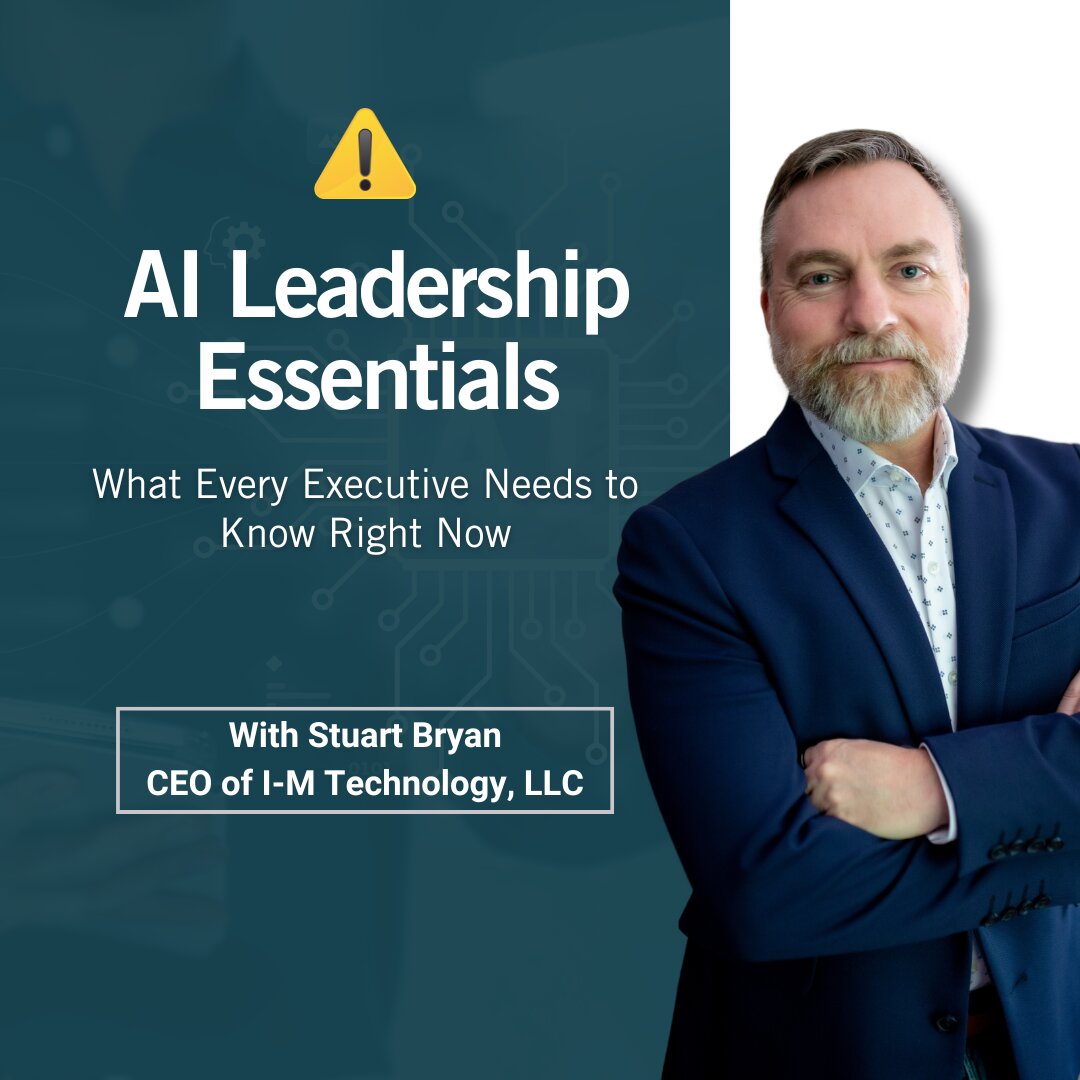
If your organization hasn't started thinking seriously about AI adoption, the window for a comfortable, deliberate transition is narrowing. That was the core message of our recent executive webinar, AI Leadership Essentials.
Stuart walked business leaders, NonProfit executives, and organizational decision-makers through a practical, no-jargon framework for leading AI adoption — not as a tech project, but as a strategic imperative.
Here's What We Covered
Part 1: The New Frontier — The Cost of Waiting
The global AI market has accelerated at a pace few predicted. But here's what matters most for leaders today: powerful AI tools are no longer reserved for large enterprises. They're accessible to organizations of every size — and your competitors may already be using them.
Stuart opened with a challenge: "If another organization in your space suddenly became 40% more efficient serving more clients at a lower cost with faster turnaround... how long before you felt it?"
The reality is that organizations already exist.
Real-world examples from the webinar:
- Data entry tasks that once took 12 hours per week reduced to under 15 minutes
- Organizations serving more people with the same level of staff
- Administrative roles being restructured as AI handles the repetitive work
Every quarter that thoughtful AI adoption is delayed is a quarter where faster-moving organizations pull further ahead.
Part 2: Strategic Alignment — Connecting AI to Real Goals
Enthusiasm for AI is not a strategy. Neither is a shopping list of tools.
Stuart introduced a 5-Step AI Business Alignment Framework used with I-M Technology clients:
- Define clear organizational outcomes — not "we want to use AI," but specific goals like reducing processing time by 50% or automating 80% of routine inquiries
- Assess AI readiness across five dimensions: Strategy, Data, Technology, People, and Process
- Identify capability gaps — where you are today vs. where you need to be
- Prioritize by impact — the most valuable use cases, not the most exciting ones
- Build a phased roadmap — early wins first, then scale
"Don't start your AI journey by asking what AI tools should we buy. Start by asking what problems do we most need to solve." — Stuart Bryan
Part 3: Leadership — The Human Side of AI
Most AI initiatives don't fail because of technology. They fail because of the people.
Two sets of concerns always emerge during AI adoption:
- Leadership teams: How do we stay competitive and move fast enough?
- Team members: Will AI replace me?
Both concerns are legitimate — and both deserve honest, transparent leadership.
Stuart outlined the characteristics of leaders who succeed in AI transformation:
- Curious rather than certain
- Transparent rather than promotional
- Urgency balanced with patience
- People-first mindset — always
Common cultural barriers include fear of job loss, low digital confidence, and the classic "we've always done it this way." The antidote? Start small, create early wins, and invest in internal AI champions — who may not be your most senior person.
Part 4: AI Literacy for Executives
You don't need a computer science degree to lead AI adoption. But every executive should understand a few core concepts:
- Machine Learning — systems that learn from data to make predictions
- Generative AI — tools that create new content (text, images, code) based on patterns
- Data quality matters — AI is only as good as the data behind it
- AI has limitations — human oversight is always essential
Stuart's analogy: "Think of it like a construction worker with a hammer and nails vs. one with a nail gun and compressor. You still need the person — you've just made them far more efficient."
Key questions to ask before adopting any AI tool:
- What data does this tool require?
- How does it integrate with our existing systems?
- What does long-term maintenance actually look like?
- Does it meet our compliance requirements?
Part 5: Execution, Culture & Scaling
Culture is the operating system that determines whether your AI strategy actually runs.
Key principles:
- Celebrate attempts, not just outcomes — create psychological safety around AI experimentation
- Break down silos — AI creates the most value at the intersections between departments
- See AI as a partner, not a threat — help your team eliminate drudgery and focus on meaningful work
- Build reusable components — so each new implementation costs less than the last
AI strategy is not a one-time event. It is an ongoing commitment.
5 Key Takeaways
- AI is a strategic imperative — the question is no longer whether you'll adopt it, but how thoughtfully you'll do it
- Leadership drives transformation — not technology
- Start with the business problem, not the tool
- Culture and management change determine success more than any platform
- Continuous learning is not optional — make AI literacy a permanent organizational habit
Questions? Let's Talk.
This is the first in a series of webinars I-M Technology, LLC is hosting on AI leadership and adoption. Whether you're just getting started or ready to scale, we're here to help you build a strategy that actually works for your organization.
📩 Contact us at I-M Technology to request a consultation or learn about upcoming sessions in this series.