



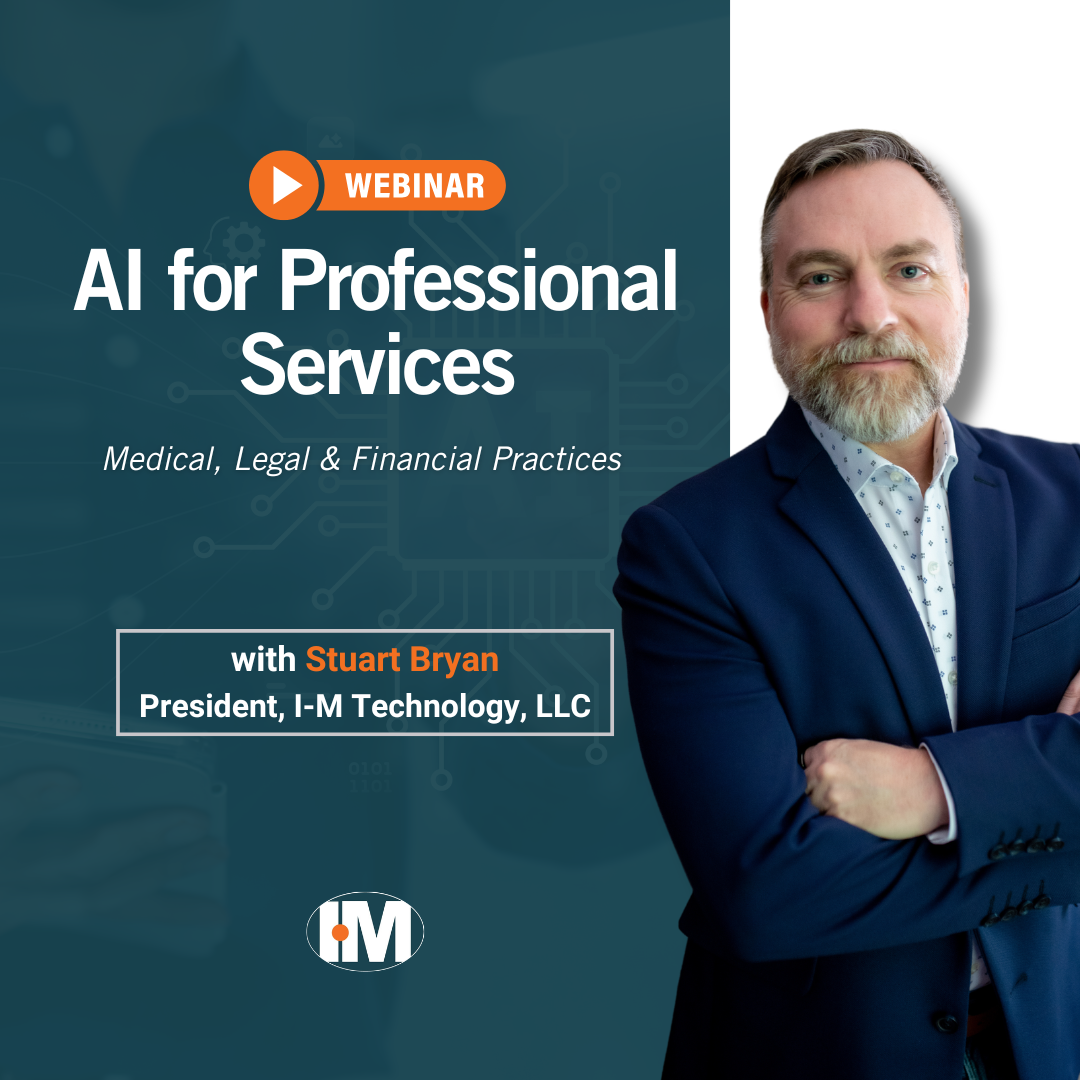
By Stuart Bryan · I-M Technology · Norwich, CT
In many industries, a bad answer is inconvenient. In professional services, a bad answer can become a compliance issue, a patient safety event, a breach of privilege, or a financial risk. That changes the conversation about AI considerably.
AI has real potential in medical, legal, and financial practices. The opportunity is significant. But it should be handled with structure, clear boundaries, and the right people in the loop. The goal is not to replace professional judgment. The goal is to support it and give professionals more time for the work that only they can do.
Start With Administration, Not Judgment
The best AI use cases in professional services are almost always administrative first. Scheduling, intake, documentation, reminders, billing support, documentation review, reconciliation, research support. These are areas where staff time gets eaten up but where the professional is still responsible for the final result
That is the right starting point because administrative tasks often carry lower regulatory risk, produce measurable outcomes, and build confidence in the technology before it touches anything more sensitive. Find the work that is repetitive, time-consuming, and painful and start there.
Healthcare: Reducing Burden Without Increasing Risk
Staff in healthcare are already stretched. Patients are already frustrated by delays, phone trees, paperwork, and missed communication. AI can help, but the implementation has to keep patient safety and privacy at the center.
Scheduling, billing, coding support, prior authorization workflows, and routine follow-ups can all consume enormous staff time. AI can help organize and accelerate that work without removing accountability. It removes repetitive friction, not the professional responsibility.
Clinical decision support is a different matter entirely and deserves serious care. AI can surface relevant history, flag potential interactions, and help organize information. But it should support clinical judgment, not replace it. The provider always remains responsible. AI trained on incomplete or biased data will produce conclusions that reflect those gaps. It should assist, not decide.
I was in a specialist's office recently. In the examination room, there was a person sitting off to the side whose only job was to transcribe notes into the EHR software. Everything the doctor said, everything they observed, every next step, this person captured it. The specialist moved on to the next room. The notes stayed behind.
That is a payroll position for a task that AI can now handle. Tools like Plaud and others can capture patient interactions through voice transcription in HIPAA-compliant environments. Some EHR platforms now have this capability built directly into the interface. When I was at my vet recently, the software had a record button built right in. The vet asked my permission, I agreed, and the visit was captured. No separate device, no manual entry after the fact.
One practical tip on transcription accuracy: give the tool a list of phrases, words, abbreviations, and acronyms specific to your practice before you start. Many transcription tools allow for a custom vocabulary or industry selection. That preparation dramatically improves the output.
El Rio Health, an Arizona FQHC, implemented AI-powered appointment reminders. The direct results were fewer no-shows, more confirmations, added revenue, and reduced staff time spent on manual outreach. When AI is applied to a painful but measurable workflow, it can create real operational impact.
Legal: Powerful Potential, Serious Obligations
Legal practices have significant AI opportunity and serious confidentiality and ethical obligations that do not bend. AI can help attorneys and staff move faster. It cannot be allowed to compromise privilege, confidentiality, or professional responsibility.
Contract analysis is one of the strongest use cases. AI can flag clauses, compare language, identify unusual terms, and summarize risks, saving meaningful time on first-pass review. But AI cannot be the final reviewer. Attorney judgment is still the value being delivered.
I heard recently about someone who had shared details about an open legal matter in a public AI chatbot rather than with their attorney. Because that conversation happened outside privileged communication, it was not protected. It was admissible. Even as a consumer of legal services, the channel where you discuss sensitive matters determines whether it is protected.
I have used AI to help me think through a situation before sending something to our attorney. I stated my overall concerns and had a draft response prepared to help me organize my thoughts, without being specific about the actual details of the situation. The attorney then made their own thoughtful response. That is what I pay for. That is what your clients pay you for. Not to flip AI output back to somebody unedited.
AI can support legal research, first drafts of routine documents, and client intake workflows. Intake automation is especially useful because it creates consistency and reduces unnecessary back and forth. But the forms should reflect your real workflows, designed by your team based on what you know happens, what gets missed, and what has to be caught. Go back and review your last ten or fifteen onboardings. Look at what information is common across all of them, where you have gaps, and build from that. AI can help you format it. You should be the one deciding what goes in it.
Do not allow staff to experiment with sensitive client materials in public AI tools. That is not innovation. That is unmanaged risk.
Financial Services: From Manual Processing to Insight-Driven Service
Accounting, advisory, insurance, and related firms all handle large volumes of structured and semi-structured data. AI can find patterns, reduce manual entry, and identify issues faster.
Automated reconciliation and bookkeeping support can reduce both repetitive work and the errors that come with it. AI can classify transactions, identify anomalies, and support review. But financial controls still matter. AI should not be making unchecked changes to the books.
Fraud detection is a strong use case because AI is good at spotting patterns that humans miss at scale. Duplicate payments. Suspicious timing. What I call impossible transactions: activity that happens too fast for a human to have initiated, or a transaction in one location followed immediately by one on the other side of the world. For smaller firms, this creates a level of monitoring that used to require much larger teams.
Predictive analytics can help advisors identify client needs, trends, risks, and opportunities earlier. Not because AI predicts the future perfectly, but because it helps prepare better questions. And better questions lead to better conversations. The advisor becomes more valuable, not less, because they arrive prepared. The conversation happens with the advisor, not the AI.
Compliance monitoring is another strong application, with one important caveat: a tool that generates too many false alarms becomes noise that gets ignored. Like the boy who cried wolf, if it fires constantly, people stop paying attention. A tool that misses key issues is even more dangerous. Design and tuning matter.
What All Three Have in Common
Medical, legal, and financial practices share the same characteristics: sensitive data, high trust, regulatory obligations, and a need for accuracy. The approach to AI across all three follows the same logic. Start with lower-risk administrative workflows. Get that right. Prove value. Then expand carefully.
Before any of it, your IT partner, whether that is an internal team or an MSP, should help evaluate vendors, secure data, manage access, support compliance requirements, integrate systems, and plan the rollout. And I want to be direct about something: this is not work to bundle into basic services. It is project work with project scope and project cost. That is not a reason to avoid it. It is a reason to treat it seriously and demand a return on investment conversation before you start.
This is not a software decision or a simple rollout. It is an operational and risk-based decision. The right partner needs to understand both the technology and the business environment you operate in.
Three Things Worth Doing First
Identify the top three administrative tasks consuming staff time in your practice, ideally ones with low regulatory risk. That is your starting point.
Evaluate any AI tools you are considering against your specific compliance obligations: HIPAA, state bar rules, SEC requirements, privacy laws. Do not rely on a vendor's marketing copy as your compliance review. A vendor saying they are HIPAA compliant is a starting point, not an endpoint.
And if you are in a regulated practice, consider bringing in a compliance specialist before implementation. That review feels slow. It is much faster than cleaning up a mistake.
AI can make professional services more efficient, more responsive, and more valuable. But it has to be implemented with discipline. Do not chase novelty. Solve real problems. Protect trust. Keep humans accountable. That is how AI becomes an asset instead of a liability.
Want to know how AI fits your practice?
I-M Technology serves NonProfits, and Small Businesses across Connecticut and Rhode Island. We help evaluate vendors, secure your environment, and build a rollout plan that fits your compliance obligations.
Schedule a free discovery call or call (866) 755-4486.