



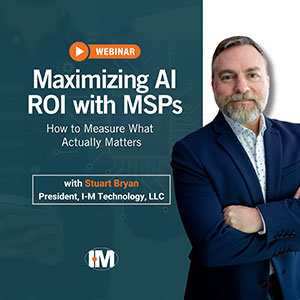
At some point, every AI conversation has to stop being about potential and start being about results. Session 4 of the AI Leadership webinar series was built around exactly that shift. From should we do AI to are we actually getting value from it.
For NonProfits and SMBs, ROI is not optional. Budgets are tight, resources are stretched, and every initiative has to justify itself. Stuart Bryan, founder of IM Technology, walked through a practical framework for measuring and maximizing AI return on investment — one grounded in full cost, not just headline benefit.
Execution Is the Hard Part — Not the Idea
Many organizations do not struggle with ideas. They struggle with executing those ideas at scale. AI is no different.
The EOS Traction framework draws a useful distinction between the visionary — the leader generating the ideas — and the integrator — the person responsible for making them happen. That execution gap is where many AI initiatives stall. The vision is clear. The implementation is not.
AI requires skills, tools, and processes that many NonProfits and SMBs do not have in-house. A capable MSP fills that gap — providing the execution capacity to move forward without overloading your team or stalling on a $140,000-a-year hire.
When evaluating what an MSP partnership actually contributes, four categories of value are worth tracking: expertise you gain access to, speed of deployment, the ability to scale resources up or down, and a shift from fixed capital costs to flexible operating expenses. For NonProfits with grant-driven budgets decided months in advance, that last point can determine whether a project moves at all.
Worth Noting
If your MSP is not proactively talking to you about AI and productivity improvements, that is a signal. It may reflect a transactional relationship, or a gap on their side. Either way — a true MSP partner brings ideas to the table. They do not just close tickets.
The ROI Framework — Four Buckets
Many organizations approach ROI too narrowly. A single cost-benefit calculation misses too much. A more complete picture comes from thinking across four categories:
- Hard savings — direct, measurable reductions. A tool you cancel because AI now does the job. A manual process fully automated. These are the clearest wins and the easiest to defend to a board or a funder.
- Soft savings — time and productivity gains that are real but harder to quantify. Often a game of inches, accumulating gradually across everything the team does.
- Avoided costs — risks you did not have to deal with. A breach that did not happen. A compliance gap caught before the audit. Invisible when they work, which makes them easy to undervalue.
- Value creation — growth and new opportunity. A new service offering, a new grant category, the ability to serve more people with the same team.
Together, these four buckets give you a more honest picture than any single metric. They also make the case for AI investment more clearly to boards and funders who need to see the full picture, not just the headline number.
Total Cost of Ownership — What Organizations Miss
ROI is not just about benefits. It is about full cost. Many organizations underestimate what AI actually costs to run, which leads to inaccurate assumptions and disappointment when the numbers do not work out.
The full picture includes MSP fees, internal staff time for training and oversight, infrastructure, and token or credit costs from AI platform vendors. Those token costs deserve particular attention. Agentic AI workflows — where AI takes sequential actions autonomously — are significantly more expensive than standard generative AI tasks. Understanding the difference matters before you build something that scales in cost faster than it scales in value.
A useful frame: spending more tokens to complete something in two hours instead of two weeks is not always wasteful. The question is whether the outcome justifies the cost. Your MSP should be helping you think through that tradeoff — not leaving it to you to figure out alone.
The Data Safety Question Nobody Is Asking
One of the most important moments in Session 4 was a detour Stuart took on data lakes and on-premise storage — a topic that rarely comes up in AI conversations but directly affects risk.
As AI tools become more capable and more connected to live systems, the risk of something going wrong at the source increases. A data lake aggregates information from all the tools your organization uses into a single location. The growing interest is in running that aggregation on-premise — storing a copy of your data on a physical device or controlled environment rather than giving AI tools direct access to your live databases.
Why This Matters for NonProfits
AI tools with direct access to live databases carry real risk. Working from a copy of the data rather than the live source preserves the analytical value of AI while significantly reducing the risk of irreversible damage. Your data stays yours — protected, aggregated, and queryable without the exposure.
The practical model: do the processing and AI work in the cloud where the elasticity is. Store the underlying data in a more controlled environment. You get the capability without the exposure.
AI, Cloud, and MSP — A System, Not Three Separate Things
AI does not operate in isolation. It needs infrastructure to run on and expertise to manage. Think of AI, cloud, and MSP support as three interdependent elements: AI delivers the capability, cloud provides the scalable infrastructure, and the MSP manages and optimizes both.
When these three are aligned, you get faster implementation, lower costs, and better outcomes. When they are misaligned — when the MSP does not understand the AI tools, or the cloud environment is not configured for the workload — you get inefficiency and ROI that never materializes.
The goal, as Stuart put it, is disciplined and informed decisions that improve outcomes over time. Not chasing hype. Not one-time calculations. A consistent, measurable process that makes AI a driver of growth rather than just another expense.
Up Next — Session 5: AI Implementation Masterclass
June 17th
We move from measurement into execution. How do you actually build and deploy AI in a NonProfit or SMB environment without the missteps that derail most projects?
Email info@i-mtechnology.com to get on the invitation list. Sessions 1 through 4 are available now at i-mtechnology.com/blog.