



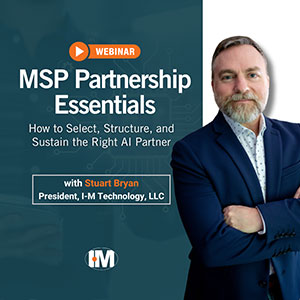
For many NonProfit organizations and Small Businesses, the conversation about AI moves quickly to tools. Which platform? Which vendor? Which integration? But the harder, more consequential question comes before any of that: who is going to help you deploy it, secure it, support it, and make sure it produces value?
That question sits at the center of Session 3 of our AI Leadership for NonProfits webinar series. Stuart Bryan, founder of IM Technology, walked through a practical framework for evaluating, selecting, and managing an MSP partnership — one built to deliver real outcomes instead of expensive experiments.
Here is what was covered.
Part 1: Why the MSP Advantage Matters
Many NonProfits and SMBs do not have a bench of AI strategists, data specialists, cybersecurity experts, and implementation managers on staff. Those roles often end up as fractional hats someone wears in addition to their actual job — which is not a sustainable model for serious AI adoption.
A capable MSP shortens the learning curve, reduces risk, and helps you move faster than you could by building everything internally. The goal is not to hand over your strategy — it is to gain a partner who helps you execute that strategy without having to build an entire department first.
A good AI-focused MSP does more than install software. They should help you answer questions like:
- Are we ready?
- Where do we start?
- How do we protect the data?
- Who owns what?
- How do we know it’s working?
If a provider cannot connect their services to those practical outcomes, they are probably not the right fit.
Build vs. Partner: Three Models to Know
- Build internally: More control, but slower, more expensive, and harder to sustain long-term.
- Partner externally: Faster to move, lower burden on your team, but requires trust and strong oversight.
- Hybrid model: Often the best fit for NonProfits and SMBs. Let the MSP handle the foundational work while your internal team stays focused on the mission.
Part 2: How to Select the Right AI Partner
Selection is where organizations either set themselves up for success or create future headaches. The wrong partner can waste time, money, and trust.
What to Evaluate
Do not choose based on personality, price, or how polished the sales presentation felt. Evaluate on:
- Track record and relevant experience in your sector
- Security capability and compliance awareness
- Communication style and responsiveness
- Business stability — how long have they been doing this, and specifically this?
- Understanding of NonProfit realities: budget constraints, board expectations, grant-driven reporting, and lean staffing
Questions Worth Asking
Useful questions worth asking:
- How do you assess readiness?
- What does implementation look like?
- How do you handle security, privacy, and compliance?
- What support exists after go-live, or does the project just end?
- How do you define success and does that definition match ours?
- What tends to go wrong, and how do you handle it?
That last question is especially revealing. You can learn a lot about a provider by how honestly they talk about risk, friction, and responsibility.
Red Flags to Watch For
- Promises of dramatic outcomes in unrealistic timelines
- Pricing that is intentionally hard to compare
- Conversations about tools with no mention of process, people, or governance
- Poor communication during the sales process
- No meaningful questions about your organization, your data, or your goals
- No relevant industry experience — pivoting into AI from an unrelated field is not the same as building expertise in it
Part 3: Structuring the Partnership
Once you select a partner, the next step is making the relationship operationally sound. Good intentions are not enough. Clarity is what protects both sides.
Partnership Models
- Project-based: A defined initiative with a firm beginning and end.
- Ongoing advisory: Regular support and guidance without full operational ownership.
- Managed service: The MSP takes on significant operational responsibility.
- Co-innovation: Both sides build something collaboratively over time.
The right model depends on your internal capacity, the complexity of your use case, and how strategic AI is to your long-term plans.
Define Success Before the Work Starts
Success should be defined before anyone signs anything. That means agreeing on what outcomes matter, what “good” looks like at 90 days, six months, and one year, who owns which responsibilities, how often you meet, and what gets escalated and how quickly.
Contract Considerations
Contracts matter because they protect the relationship when things get difficult. Pay close attention to:
- Scope and deliverables
- Service levels and response times
- Data ownership — who owns what was built, and who owns the output?
- Intellectual property terms
- Exit terms and knowledge transfer — you want a partner relationship, not a hostage situation
Part 4: Ensuring Long-Term Value
The best partnerships get stronger over time because trust increases, communication improves, and the work becomes more aligned to the business. But that does not happen on autopilot.
If you treat your MSP as a commodity vendor, you will get commodity results. The better approach is to treat them like a strategic partner while still holding them accountable. That means sharing context, explaining business priorities, and helping them understand where your organization is headed. The more they understand your direction, the better they can support the journey.
A few practices that keep partnerships healthy:
- Regular check-ins and business reviews, not just at renewal time
- Honest conversations when something is off track — do not wait
- Review responsiveness, strategic value, and whether the provider is helping you grow — not keeping you dependent
- Share context freely. Sign an NDA if needed, then be open about your business plans, challenges, and direction
- Catalog your vendor relationships and technology stack so the MSP understands the full picture
Also recognize that what you need from an MSP in year one is not what you’ll need in year three. A strong partner will grow with you, not maintain the old model indefinitely.
Key Takeaways
- Selection requires real due diligence, not just a good pitch and a low price.
- Define success before work starts. Vague expectations lead to real disappointment.
- Contracts protect the relationship. Pay attention to data ownership and exit terms.
- Treat your MSP as a strategic partner, not a vendor — and hold them accountable to that standard.
- Review the partnership consistently and evolve it as your AI maturity grows.
Practical Next Steps
Before you meet with any provider, do this internal work first:
- Define the outcomes you are trying to achieve
- Identify the internal gaps you are trying to fill
- List your non-negotiables — budget, timeline, compliance, staffing
- Build an evaluation scorecard before the conversations start
- Talk to multiple providers and check references
- Where possible, start with a pilot before committing to a larger engagement
One tool worth using: Business Model Canvas. It is a free resource that helps you clearly map your organization’s functions and priorities — and it gives any MSP partner a much clearer picture of how your organization works. Email us at info@i-mtechnology.com and we will send you the template.
Join Us for Session 4
Up next: Maximizing AI ROI with MSPs. Session 4 on May 14th at noon. How do you measure and maximize the return on your AI investment? We’ll cover that in detail. Invitations will go out by email.
Missed Sessions 1 or 2? Both are available here.