



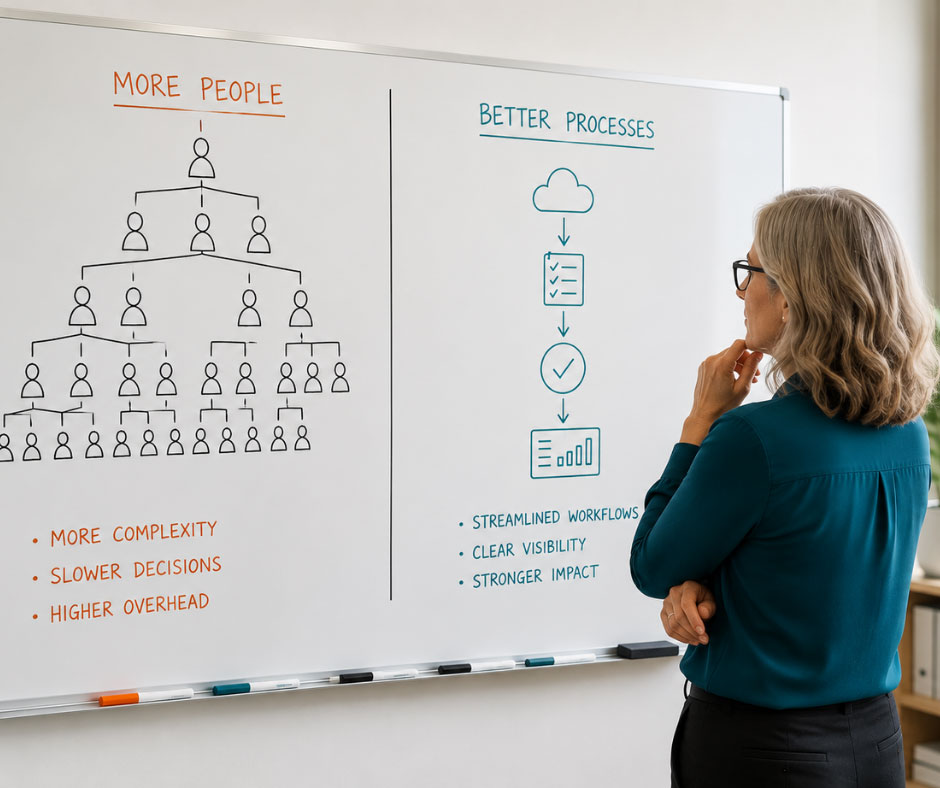
Why Growing NonProfits Need Better Systems And Not Just More Staff
If you've led a NonProfit for any length of time, you've probably experienced this.
A new grant is awarded.
Demand for services increases.
Your team is stretched thin.
The first solution that comes to mind?
Hire another person.
Sometimes that's exactly the right decision.
But after working with NonProfits for more than 20 years, I've noticed a pattern that rarely appears on a financial statement.
Many NonProfits are solving process problems with payroll instead of fixing the systems that create the work in the first place.
Adding staff can temporarily relieve pressure. But if inefficient processes remain, new employees often inherit the same frustrations as everyone else.
Technology isn't just about keeping computers running.
It's about giving your team the systems they need to focus on serving your mission—not fighting inefficient processes.
The Hidden Payroll Cost of Inefficient Technology
Many NonProfit leaders budget carefully for salaries and benefits.
Few calculate the hidden payroll cost of inefficient systems.
Think about how much time your staff spends each week:
- Searching for documents.
- Entering the same information into multiple systems.
- Manually preparing grant reports.
- Resetting passwords.
- Troubleshooting software.
- Waiting for applications to load.
- Tracking down spreadsheets.
- Answering technology questions from coworkers.
None of these activities move your mission forward.
Yet together, they consume hundreds of hours each year.
Those hours aren't technology costs.
They're payroll costs.
When Your "Technology Person" Becomes Everyone's IT Department
Nearly every NonProfit has one.
The person who's "good with computers."
Maybe it's your Operations Director.
Maybe it's someone in Finance.
Maybe it's your Executive Assistant.
Eventually everyone knows exactly who to call whenever technology isn't working.
Before long, they're:
- Resetting passwords.
- Ordering laptops.
- Contacting software vendors.
- Fixing printers.
- Helping coworkers connect to Wi-Fi.
- Managing Microsoft 365.
- Answering technology questions all day.
None of that was in their job description.
More importantly, none of it advances your mission.
When one employee becomes your unofficial IT department, your organization creates unnecessary risk.
What happens when they're on vacation?
What happens if they leave?
What happens during a cybersecurity incident?
Your technology strategy shouldn't depend on one helpful employee.
Better Processes Reduce Burnout
One of the biggest challenges facing NonProfits today isn't technology.
It's people.
Executive Directors across Southern New England are working hard to recruit, train, and retain talented staff while demand for services continues to grow.
Adding another employee isn't always possible.
Improving the way work gets done often is.
Imagine if your team could spend less time:
- Searching for information.
- Creating manual reports.
- Responding to technology problems.
- Re-entering data.
- Managing disconnected systems.
And more time:
- Serving clients.
- Building donor relationships.
- Writing grants.
- Measuring program outcomes.
- Collaborating with one another.
That's what well-designed technology should accomplish.
Better Systems Create Better Data
Today's funders expect more than compelling stories.
They expect measurable outcomes.
That means your NonProfit needs accurate, accessible, and reliable data.
If staff are maintaining multiple spreadsheets, manually combining reports, or questioning which version of a document is current, reporting becomes slower and less reliable.
Modern technology—including AI—can help automate reporting, organize information, and improve decision-making.
But only if the underlying systems are organized first.
Reliable reporting begins with reliable systems.
Technology Is Capacity Building
Many NonProfits think of technology as overhead.
The most successful organizations see it differently.
Technology strengthens nearly every part of your organization:
- Client services
- Donor engagement
- Grant reporting
- HR onboarding
- Volunteer management
- Cybersecurity
- Compliance
- Staff productivity
- Executive decision-making
When these systems work together, your organization becomes more resilient, more efficient, and better prepared for growth.
That's not simply an IT improvement.
That's organizational capacity building.
Technology Should Help Your Team Do More Good
At I-M Technology, we believe NonProfit technology should do more than keep computers running.
It should reduce administrative burden, improve collaboration, strengthen cybersecurity, and help your staff focus on the work that changes lives.
Through our Tech4NonProfits approach, we help social service and health & human service NonProfits across Southern New England optimize technology, improve operational processes, and strategically implement AI so organizations can grow without adding unnecessary complexity.
Because when your systems support your people, your people can better serve your mission.
Ready to Build Capacity Instead of Adding Complexity?
Schedule a complimentary discovery call where we’ll discuss about your NonProfi’s optimization plan.
Together, we'll identify technology bottlenecks, uncover opportunities to streamline operations, and build a roadmap that helps your staff spend less time working around technology—and more time delivering impact.