


AI LEADERSHIP FOR NONPROFITS AND BUSINESSES
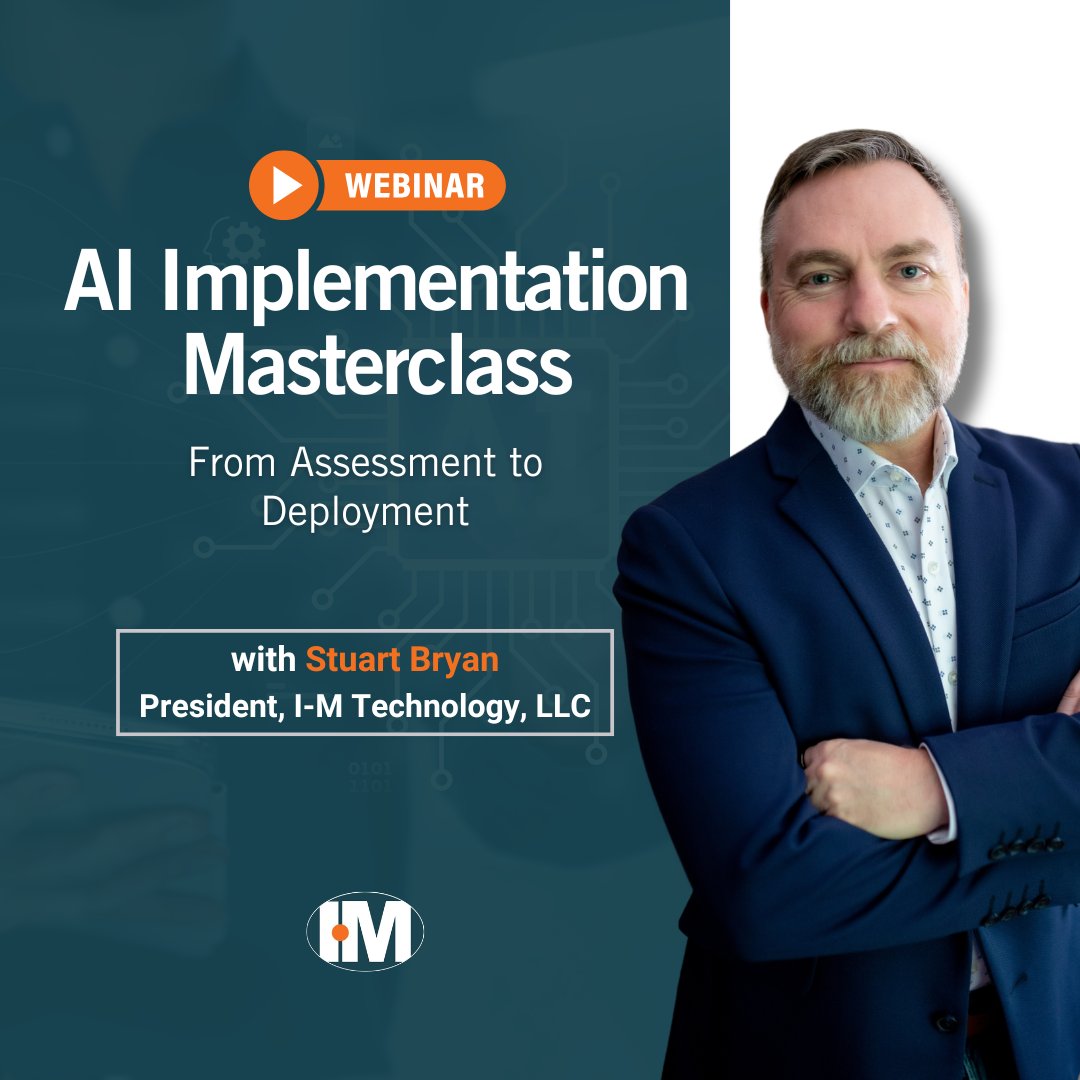
Strategy without execution is just a plan. Session 5 of the AI Leadership for NonProfits webinar series was built around the step many organizations rush past — implementation. How do you move from deciding to do AI to having something working, trusted, and delivering results.
Stuart Bryan, founder of IM Technology, based in Norwich, Connecticut, walked through a four-part framework: readiness assessment, opportunity identification, implementation planning, and scaling what works. The goal is not to turn anyone into a technical expert. It is to give leaders a clear enough framework to lead implementation with confidence.
Assess Readiness Before You Touch a Tool
A lot of AI failures are not technical. They are operational. Organizations jump to tools without defining outcomes, and that leads to frustration and abandoned initiatives. Before deploying anything, you need an honest picture of where you stand.
There are five areas to assess: strategy, meaning outcomes are defined before tools are selected; data quality, accessibility, and consistency; technology, whether your systems are stable, secure, and capable of supporting new tools; people, whether your team understands AI and is open to change; and process, whether your workflows are defined clearly enough to automate. You do not need perfection in any of these areas. You need awareness of where you stand today.
Stuart described a recent conversation with a Connecticut-based organization where a routine security check revealed that staff had far too much access to sensitive systems — some with administrator-level permissions in an unlocked Microsoft 365 environment. Had AI been enabled on that network in that state, data could have ended up where it was never meant to go. The readiness check caught it before any damage was done.
Data readiness deserves particular attention. AI is only as accurate as the information it is given. Stuart described going through a data cleanup process before implementing AI in IM Technology's own organization — not deleting data, but re-categorizing and reorganizing it so that conclusions drawn from it would be reliable. His framing: garbage in, garbage out. And his advice: do not wait for an AI initiative to force this work. Start it now.
On technology, the standard is not cutting edge. It is stable. Some tools your organization uses today may not have API access or the ability to export data in a usable format. That does not necessarily mean replacing them — but it does mean understanding the constraint and planning around it.
Find the Right Place to Start
Once readiness is understood, the next question is where to begin. Stuart's framing came from a quote by W. Clement Stone: small hinges swing big doors. The best starting points are repetitive, time-consuming tasks and areas where delays create friction. Not ambitious transformation out of the gate. Practical wins that build momentum and prove the model before it scales.
When evaluating which use cases to prioritize, four filters are worth applying: impact, meaning how significantly this will improve an outcome; effort, meaning how much time, resource, and complexity is involved; risk, meaning what are the data, adoption, and integration exposures; and alignment, meaning whether this connects to your stated organizational goals.
Stuart described a situation he was dealing with at the time — an integration tool that was granting broader access to data than he was comfortable with. Rather than enable it with inadequate controls, he scheduled a meeting with the vendor's development team to request more granular permissions. The point: your data is an asset and a risk. If the level of control you need is not available, that is a reason to pause, not proceed.
Building a business case matters even in smaller organizations. The questions to answer before moving forward: what will improve, how will you measure it, and what resources are required. Vague outcomes do not get funded or supported. Specific ones do. Not better reporting — reduce monthly reporting time by defining a repeatable process. Not improved efficiency — increase grant application output by automating the first draft. Measurable, specific, and tied to something that matters to the organization.
Plan Before You Build
Planning determines how smooth or painful the rollout will be. Define scope and objectives specifically. What exactly is being implemented, who is involved, and what does success look like. Vague scope leads to scope creep and missed expectations.
Every initiative needs one named, directly responsible person. Without clear ownership, tasks get delayed, accountability disappears, and progress slows. Set realistic timelines — too aggressive leads to burnout, too slow loses momentum. And identify what could go wrong before it does. Stuart called this the pre-mortem: think through what could cause the initiative to fail, build contingencies, and test the plan before the work starts. The goal is to be a little negative in planning so you can be a lot more confident in execution.
One addition worth noting: before defining scope and objectives, go to where the work happens. Talk to the people doing it. Understand the full process from start to finish. Leaders who skip this step often build solutions for a process they do not fully understand.
Execute, Then Scale What Works
Execution comes down to three things: training, tracking, and iteration. If people do not understand how to use the tools, they will revert to old habits. Training and documentation are not optional. The good news is that AI can help build the SOPs, runbooks, and guides that make adoption easier — so the lift is lighter than it used to be.
Track early outcomes. Those initial wins build the confidence and organizational momentum that sustain the work over time. Adjust based on feedback and results. Small refinements over time create significant improvements — it is a game of inches, not a single leap.
On scaling, the principle is to replicate success, not experiments. Get a use case out of the pilot phase and into consistent, reliable performance before expanding it. Stuart's standard: if something is right 80 or even 95 percent of the time, that may not be good enough depending on what it is doing. Set the right bar, reach it, then ship it and iterate.
Stuart used the Tesla Model S as an analogy. Over the course of the car's production run, Tesla made a massive number of incremental changes — reducing parts, reducing complexity, improving reliability. Parked side by side, the first year and last year models look similar. But internally, they are dramatically different. The compounding effect of small, consistent improvements is where real gains come from.
The same principle applies to AI implementation. Continuous measurement, iterative improvement, and ongoing training are not the end of the project. They are the project. AI implementation is an ongoing capability, not a one-time initiative. Organizations that treat it as a destination tend to stall. Organizations that treat it as a discipline tend to pull ahead.
Three Things Worth Starting Now
Run an honest readiness assessment across all five areas — strategy, data, technology, people, and process. You do not need to score perfectly. You need to know where the gaps are. Start your data cleanup without waiting for an AI initiative to force the issue. Organize your data so it is accurate, categorized, and accessible. And identify one high-impact, low-risk use case. Define the outcome, define how you will measure it, and name the owner.
Up next — Session 6: AI Process Automation and Customer Experience.
We move from implementation into automation, how to identify the processes worth automating, and how AI can improve the experience for the people your organization serves.
I-M Technology, LLC serves NonProfits and Small Businesses across Connecticut and Rhode Island. To receive the Session 6 invitation, email info@i-mtechnology.com.