


AI LEADERSHIP FOR NONPROFITS AND BUSINESSES
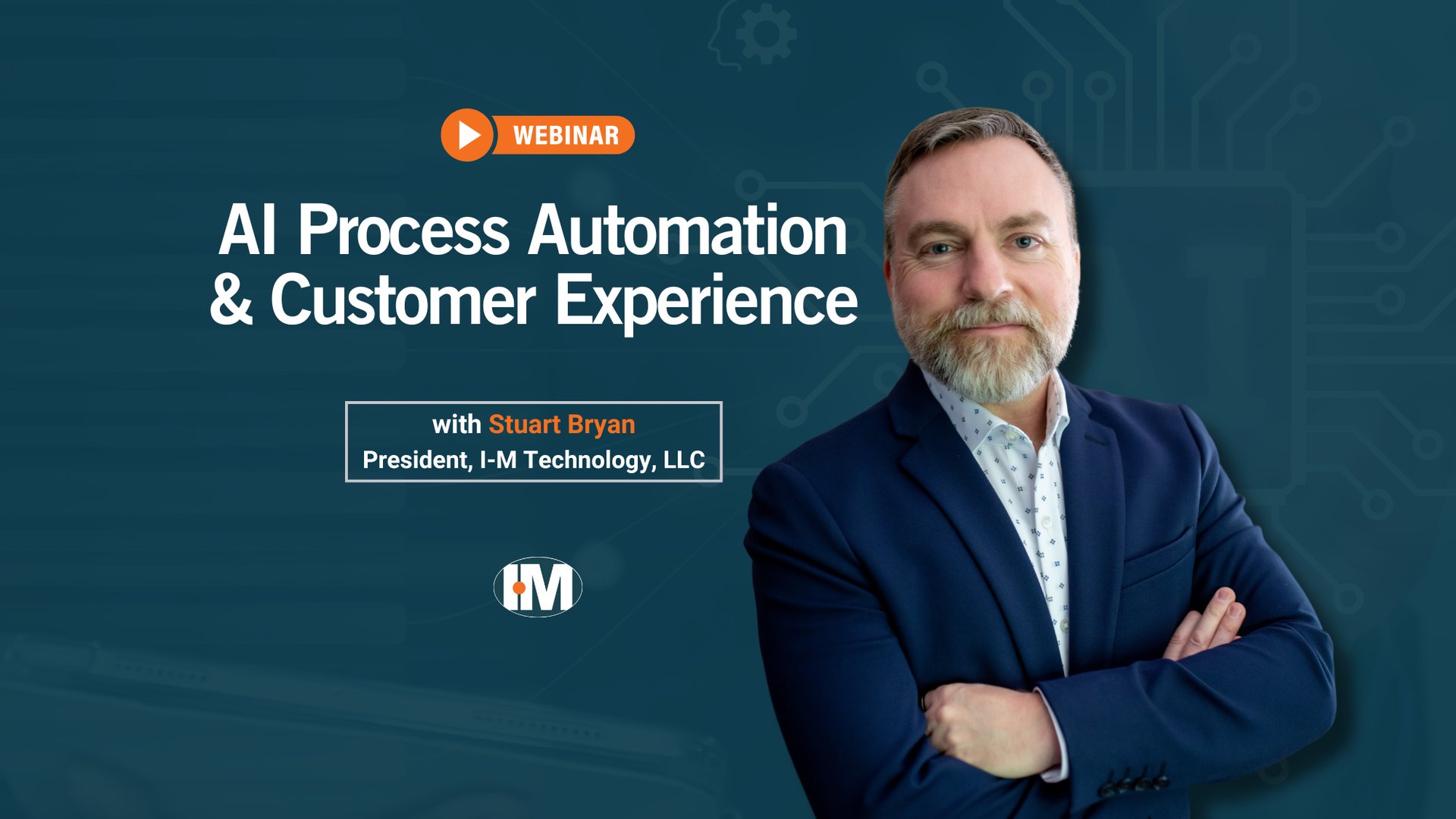
Chatbots are not magic conversation. That was the first thing Stuart Bryan, president of I-M Technology based in Norwich, Connecticut, made clear in Session 6 of the AI Leadership for NonProfits series. Chatbots can be useful, but they are only one small piece of what AI can do. The real opportunity is using AI to make your organization easier to work with, easier to run, and better able to serve the people your mission exists to help.
Many Small Businesses and NonProfits are not struggling because they lack effort. They are struggling because too much of their team's time is trapped in manual work. Copying information, chasing updates, responding to the same questions, moving data from one system to another, and fixing preventable mistakes. AI matters here because it can take pressure off the team while improving the experience for the people you serve — and at the same time, it has the ability to increase accuracy.
The Real Question Is Where Work Gets Stuck
When people hear AI and customer experience, they often picture the chat window on a website. That is fine, but it is limited thinking. The bigger question is where does work get stuck. Where do customers wait. Where do staff members repeat the same task twenty times a week.
That is where AI becomes meaningful. Not flashy, not theoretical. Practical. Think of it like a manufacturing floor. When something gets stuck at a machine waiting, that is what we are talking about — where work piles up.
What Stuart described as hyper-automation is a big word with a simple idea. It means using AI, automation, workflow, integrations, and business rules to automate not just one task but an entire process. Instead of having a person receive a request, interpret it, search for the right information, update a system, draft a response, and notify someone else — those steps can often be connected and accelerated.
Think about a customer inquiry coming in by email. Today, someone may have to open the email, read it, figure out what it is about, look up the customer record, decide who should handle it, and then respond or forward it with context. With AI-enabled automation, that same inquiry can be categorized, routed, attached to the right account, and have a draft response prepared. A person still reviews what matters. The front-end busy work gets reduced dramatically.
Your Relationship Advantage Is Worth Protecting
Small businesses and NonProfits already have something larger organizations often struggle with — relationships. You know your people, your clients, the stories hidden behind the account numbers.
AI should not erase that. Used well, AI helps preserve that relationship advantage while removing the delays and friction that make people feel ignored. Personalization used to require a lot of staff time. The salesperson who scans an office for college football teams, family photos, hobbies — that kind of effort. And sometimes it even felt transactional. AI can change that by tailoring follow-ups, reminders, and service updates based on real context instead of generic templates. The goal is not artificial sincerity. The goal is to help your team communicate with the right people at the right time with information that matters.
Your customers and donors do not always need a human at midnight, but they might need an answer, a confirmation, or a next step outside of business hours. AI can help with after-hours scheduling, answering routine questions, intake forms, status updates, and basic service requests. That means your team comes in the next morning focused on the work that requires human judgment.
Proactive Beats Reactive
The best service is not always reactive. If you are working on a car and it has broken down on the side of the road, that is reactive. If someone needs a service and they have gotten to the point where they cannot get it — that is reactive. If a construction job goes out of scope and nobody spotted it early enough, that conversation with the customer is now happening under time pressure and emotional pressure. Reactive is uncomfortable.
By moving to proactive, the conversation changes. You can have it without the pressure that comes from reacting to something that has already gone wrong. AI can help identify patterns — missed appointments, delayed paperwork, customers who have not been contacted, donors whose engagement has dropped, clients who may need support.
Stuart described it as the difference between trailing indicators and leading indicators. Instead of seeing that you ran out of food and then going to buy it, you set a minimum stock level that triggers an order automatically. You want to find those originating occurrences — the data points you can spot first that you know eventually require some response. The earlier you can get to them, the further ahead you can be.
One practical example: appointment reminders. A text message the day before. An automated call the morning of. Missed appointments are not just inconvenient — they are lost capacity. You cannot sell the same time twice. Once that time has elapsed, it is gone.
Map the Journey Before You Buy a Tool
Before buying tools, map the customer journey. How does someone first contact you. What happens next. Where do they wait. Where does information get re-entered into two systems that do not talk to each other. Where does communication fall through the cracks.
This exercise is simple but powerful. You cannot improve what you have not clearly mapped. What you are looking for is friction. Stuart described it this way: slide your hand across copy paper, then across sandpaper. The copy paper is easy. An 80-grit sandpaper — you really cannot move your hand. That is friction. And friction is where AI opportunity lives.
Friction could be a client filling out the same information multiple times. A staff member manually transferring data from a PDF into Excel. A donor waiting three days for a thank you note. Do not start by asking what AI tool to use. Do not chase the shiny new object and then try to find the business case that fits it. Start by asking where you are making life harder than it needs to be.
Not Everything Should Be Automated: The BMW Story
There was a story in the last week about a BMW dealer in Canada. A customer was interacting with an AI chatbot about a trade-in on their car — which was sitting in the service department of that very dealership at the time.
During the chat, the bot offered the customer $28,000 for their vehicle. The chatbot had a first name — not a label that said AI or bot — a person's first name. The customer took that offer to the salesperson. The dealership offered $20,000. The customer pushed back. Under Canadian law, AI staff are to be treated as human ones with respect to work product created and work performed. The dealer honored the chatbot's offer.
That chatbot cost the dealership $8,000 on a single transaction. Because the chatbot had the ability to engage in that kind of conversation with no guardrails around what it could commit to.
The lesson is not that chatbots are dangerous. The lesson is that anything involving high-risk decisions, sensitive data, financial changes, employment decisions, clinical judgment, legal advice, or major customer commitments should require human oversight. Nothing should go to a client or customer until human eyes have reviewed it.
Early AI success comes from lower-risk, repetitive, measurable processes. Start where the downside is manageable but the benefit is clear.
Integration Is Where the Real Work Is
The value does not come from one tool. It comes from connecting the systems you already use — CRM, email, calendars, ticketing, scheduling, billing, donor management, documentation, storage. That is why integration matters. AI should not become another disconnected island that your team has to manage.
If you decide to use Claude, you are building an ecosystem that lives in Claude. ChatGPT, Copilot, Gemini, Grok, an open source model — whatever you choose, ask yourself whether you are creating another silo where your business intelligence and organizational data gets stuck. You do not want another disconnected island your team has to manage separately from everything else.
This is where a strong IT partner becomes important. Picking the software is often the easy part. Making it work safely with your existing systems — thinking about data flow, permissions, security, compliance, backups, and vendor risk — that is where the real work lies. AI should make the operation simpler, not create another mess to clean up later.
Start Small and Measure What Matters
A good AI pilot is specific. Not improve customer experience — that is vague. A better pilot is to reduce response time to website inquiries from 24 hours down to 2 hours, or automate appointment reminders and reduce no-shows by 15 percent. One use case, one process, one measurable outcome.
Before you launch, define success. If you do not know what an ideal outcome looks like, you will not know when the outcome you got is not ideal. Are you measuring time saved, fewer missed appointments, faster response times, fewer manual errors, better staff morale. The number does not have to be complicated. But it has to exist. Otherwise you are left with opinions instead of evidence.
Stuart's homework from Session 6: map your current customer or client journey. Identify one step that is manual, repetitive, or frustrating. Look honestly at your CRM. And talk to your IT partner about what can be integrated safely. Do not try to automate the whole organization in one move. Pick one area and do it well.
The big takeaway from Session 6: AI-driven automation is not about replacing the personal touch. It is about protecting it. When your team spends less time chasing data and more time serving people, everybody wins — your staff, your clients, your customers, and your organization becomes easier to run.
Up next — Session 7: AI Security, Compliance and Privacy.
I-M Technology, LLC serves NonProfits and Small Businesses across Connecticut and Rhode Island. To receive the Session 7 invitation, email info@i-mtechnology.com.